One year ago today my wife and I packed up our twin 5 year old boys and moved to Europe. We left everything behind, aside from the few bags shown below.
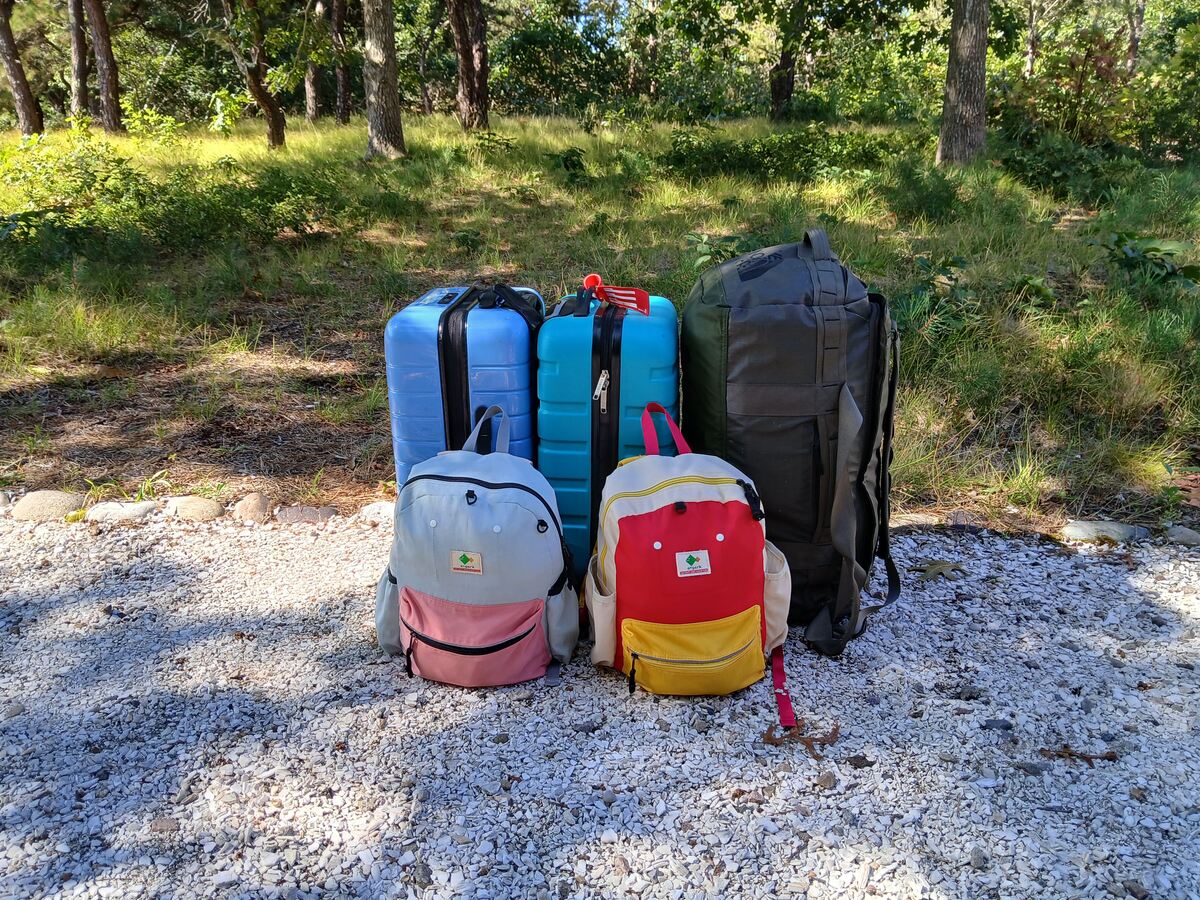
As someone who self-identified as "semi-nomadic" for the decade prior, I knew this time was different. To spend a month or two somewhere, or to be constantly "nomading," is a different thing altogether.
In picking up and moving our lives, we'd have to:
- Learn a new language
- Find our kids a school
- Pay taxes to a foreign government
- Find healthcare
- Get a Visa that would allow us to stay
Despite the logistical challenges, my experience living in Spain over the past year has been awesome. So much so, that we've decided to stay.
But more than anything it's given me an understanding of what it's like to truly live outside of your own culture. While travel may show you a glimpse of another culture, it's an altogether different beast to be a long-term guest in someone else's home. That's what this post is all about.
Becoming the ESL kid
I grew up in Manchester, New Hampshire—a place that you may not suspect of being a major immigration center. But at my high school, Manchester's Central High, 33 different first languages were spoken by kids in my graduating class. Today that number is closer to 75.
My first awareness of this came in Mrs. Leclerc's kindergarten class, where I sat next to a kid named Jose Lugo. Jose, like me, was 5 years old at the time. He was from Puerto Rico, and English was his second language. I remember school was hard for him that year, and he needed extra help from an English-as-a-second-language (ESL) teacher. We didn't talk a whole lot, because our ability to was limited.
Jose would go all the way through the Manchester public school system with me over the next 13 years. He learned English quickly, and come to find out he was a really nice kid.
Over this past year I've found myself thinking about Jose Lugo a lot. I felt like the ESL kid almost every day—and my kids actually were them.
Your welcome will reflect you
I arrived in Spain last August 30th not speaking a word of Spanish. We enrolled our kids in a predominantly Spanish (and Basque!) speaking school. I wrestled with tax forms, and bank accounts, and social security forms.
All the while, I was very aware of how I was perceived as an American. Both because of the US's active campaign to nuke its reputation and alliances globally, but even more so because of the feelings about tourism, immigration, and rising housing costs held by many in Spain.
I tried to do what I could to combat this by:
- Learning the language
- Listening more than I talked
- Defaulting to kindness
- Contributing positively to the community
- Embracing the culture at every opportunity
- Being sensitive to the fact that I'm the outsider
I've certainly put my foot in my mouth in terms of language or customs from time-to-time, but all things considered this approach made all the difference.
San Sebastian lies in the Basque Country—an autonomous region within Spain with a distinct ethnicity, language and culture. My experience has been that the Basque, the Spanish, and the many international people living San Sebastian have all been overwhelmingly welcoming.
Our friends are Basque and Spanish, loads of transplants from other parts of Latin America (Venezuela specifically), and plenty who have relocated from other parts of Europe and the US, too.
It may sound silly, but until living in Spain I never fully grasped the strength of the connection between Latin American countries. My best friend in Spain is a Spanish man who travels to Mexico almost monthly for work. I go out for drinks with a group of friends from Venezuela. And just as people in the US or Europe often think of New York or London as the center of universe, loads of folks in Latin American countries across the world think similarly about Madrid.
My worries about being an American abroad and what I read about Spain's perception of tourists and immigration were not unfounded. But my takeaway is mostly that even if people are predisposed to hold some bias against you, many good people remain who are willing judge you based on their interactions with you.
As a guest in someone's home, it's up to you to make sure that impression is a good one.
Ghost
There's so much that I've come to love about San Sebastian, the Spanish, the Basque, and generally living in Europe over the past year. There are so many things that they do better than we do in the US; so many things to which the US simply has no answer (and yes, vice versa). But that's a post for another day.
The thing that I've learned more than anything over the past year is what it's like to live outside of your own culture, because for the first time in my life that person was me. It's definitely left me with a newfound appreciation and empathy for anyone who finds themselves in this position. The US is, after all, a country comprised almost entirely of people for whom this was the case not all that long ago.
People are quick to say that you learn a language by immersion—I'm now quick to say that this is false. You learn a language by both studying it fervently as well as surrounding yourself with it. You need both—without the study, you're just immersed in a world where you don't understand.
This same concept extends to nearly all aspects of your life when you're suddenly living somewhere outside of your own culture. When traveling you can get by with a gesture and a genuine smile, pointing to items on a restaurant menu. It's short-lived in a way that your life is not. It's a band-aid on a temporary problem, but at some point you simply can't put on a band-aid every day.
So often I've felt like I was moving through the city like a ghost. Language connects us more than anything with the world around us, and without it it's all too easy to disappear.
Almost all of us derive so much of our value from what we know, our capabilities, our skills, our experiences. But when we can't communicate these things to others, we're reduced to a child-like state where we can't do much beyond communicating basic emotions. It's humbling at a level that most capable people are probably not ready for.
I can be the husband to my wife and the father to my kids that I've always been at home. I can be the co-worker in my business that I've always been on Zoom calls. But when I hit the streets, there's a world passing me by in which I can't fully participate.
I'm a ghost passing silently by.
Building relationships
Making this more difficult is the simple fact that when you're far from home, you want (and need) to build new relationships. But a prerequisite to building a relationship with someone, almost always, is the ability to communicate with them in some degree of depth. Relationships are not built on surface-level greetings or conversations about the weather.
As a result, despite my best efforts to use Spanish whenever possible conversations have quickly reverted to English when I'm speaking to another English speaking person. This also means it's impossible to build relationships with many people (English is not nearly as widely spoken in San Sebastian as it is in say Madrid). Both in turn slow progress when it comes to learning a new language.
Only as you learn the language does the feeling of being a ghost start to disappear.
The power that we all hold
The point of this post is not to bemoan the difficulty of learning a new language as an adult. Moreso, my experience has just been a revelation in terms of how much language is the connective tissue; with other people, with the world around us, with our own self-worth. When it's stripped away, we are less in terms of our ability to exist fully in the world. This is a humbling experience, and one I think more people would benefit from having.
What I've taken from this first year, more than anything, is an appreciation for the people who have gone out of their way to extend the proverbial olive branch to me. Who have been patient with my Spanish. Who've spoken intentionally slowly to me. Who have stopped to ask if I understand.
And beyond language, the people who have gone out of their way to help a stranger acclimate to their new home. Over the course of the last year, my family went through a fairly serious medical ordeal that resulted in us spending most days for several months in hospitals or doctors' offices. The number of new friends who came to our rescue with medical advice and referrals, offering to translate during doctors appointments, and answering our endless questions on the Spanish healthcare system is something I won't ever forget.
We're all consumed by our day-to-day lives, and the truth is when you're the one at home in your culture it's all too easy to miss the ghosts walking among us. To simply pass by the people who don't know the language, who don't look the same, who can't as actively reveal themselves as being an interesting and capable person.
I find myself thinking back to Jose Lugo, and wishing that I'd done more to invite him into the game of kickball at recess.
I find myself much more compelled to take 5 minutes out of my day to help the people that look obviously lost on the street corner, when they stop to ask me for directions in broken English.
When living outside of your culture, it's all too easy to feel like a ghost. This past year has been a remarkable lesson in the power that we all have to make others feel seen.
A special thank you to Sophie, Beltran, Claudia, Paolo, Pablo, Jose, Virginia, Alex, Morgan, Patrick, Jaime and the many others I'm forgetting.